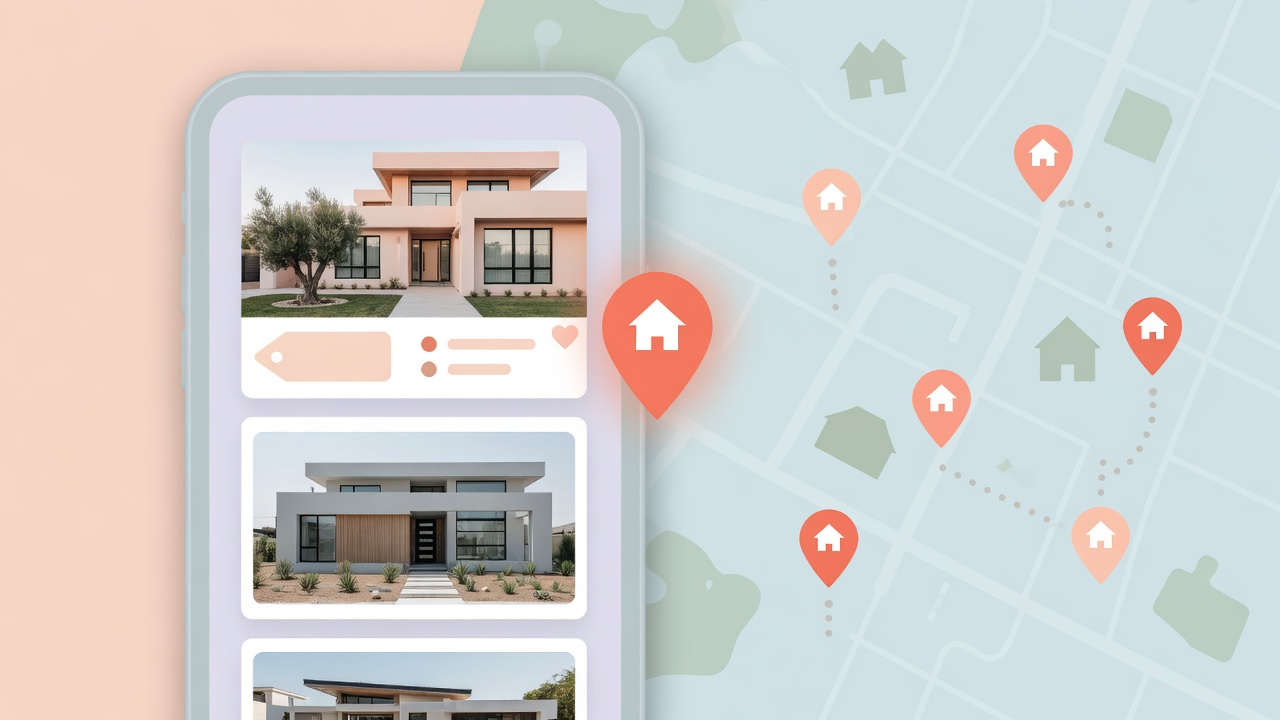
While entering the new era of digitalization, mobile applications have become a must for nearly all businesses including real estate. People prefer solving their problems, book tickets, buy food or clothes, and even rent or buy properties with their mobile phones. Real estate agents, brokers, home buyers want to be mobile and flexible. And with real estate apps, it’s easy.
Real estate apps, just like any other apps, make people’s lives more comfortable and organized. Mobile apps for real estate provide additional business opportunities and ease property management as a whole.
Table of contents
How a mobile app can help real estate management Must-have features of a real estate management app What does it cost to make a real estate management app? Final thoughts
How a mobile app can help real estate management There was a time when having a mobile-friendly website was enough for your business, but the times have changed. Now, a mobile app is an essential part of your business because more and more users prefer mobile apps to websites. According to the latest research by the National Association of Realtors , 46% of Generation Z and 58% of Millenials homeowners have found and bought their home via a smartphone. That’s a decisive factor to jump onto the bandwagon and develop a mobile app to keep up with the ever-changing times.
Need a mobile app for your business? Just drop us a line , and we’ll develop a software solution to power up your business.
So it’s pretty obvious that people prefer using mobile devices when they’re looking for flats and houses. However, apps aren’t only good for home seekers but for real estate agents, too.
Four benefits of having a real estate app Higher customer engagement and conversion Using a computer to search for information is a thing of the past, isn’t it? A smartphone is what people use to solve their daily needs. And apps are here to help and ease the way people look for and manage the property.
Stay connected with customers 24/7 Smartphones are always at hand, so real estate agents and their clients can be online anytime and anywhere. And this is what people need when they work and solve their problems on the go.
Improved property listings Real estate mobile apps can take advantage of the user’s current location and provide the best homes as well as show nearby schools, hospitals, and markets. While walking or driving around, users can see the latest listings in the nearby area. So apps make choosing a new home much easier!
Developing a mobile app for real estate is a great way to promote your business and get an additional channel for sales. Taking into account the fact that most people don’t go online, they use mobile phones and apps instead.
Must-have features of a real estate management app
The first thing that any app should do is to allow users to solve their tasks on the go. An additional set of features depends on the business model you choose. As a rule, real estate apps serve both real estate agents and buyers. Let’s find out what features are vital for real estate agents:
Login and personal profile Real estate agents need to keep all their information private but still accessible anywhere and anytime. There are 3 ways to log in and register in the app:
Social media Email Phone number It’s better to combine all these ways and let your users choose their signing method. And a personal profile of a real estate agent allows accessing a list of clients or properties anywhere and anytime.
History of closed deals and clients Building a powerful CRM system behind the app is a great way to lure real estate agents. Then your app will be the one and only tool for real estate agents to close deals and earn money.
Communication means Connecting with clients instantly via the live chat will be a considerable benefit. Moreover, consider adding a message history search tool to find and check messages easier.features vital for real estate clients
On-boarding and sign up This is a common element of any app and we strongly recommend to pay more attention to it since it’s the first screen users see when launching an application. And on-boarding is a walkthrough that helps users understand how to use the app and what problems the app can solve.
With personal profiles, users get more personalized content tailored to their needs. They can also compare and save properties, create lists, etc. And since the app needs some sensitive data such as government ID and billing information, security requires additional attention as well. Make sure your app has all required certificates such as OWASP and GDCP compliance.
Filter and search The real estate app should have a huge database of properties. For example, Zillow has 100+ million homes listed. So what’s the challenge?
The challenge is to build an easy search tool to let users quickly find what they’re looking for. Renting or buying a house is a far-reaching decision so the more filters the search has, the better it is for users.
Consider adding the following search filters:
Price Location Property type (condo, townhouse, single-family home) Listing type (resale, new construction, FSBO) Year built Lot size Extra facilities (gym, pool, laundry, parking, terrace, etc.) While looking for the house, people take into account lots of factors depending on their needs. If you have children, you will pay your attention to schools nearby. Everyone wants to live in a safe neighborhood so crime rates aren’t the last factor to consider. And these are just a few examples of how users search and find homes.
So consider adding so much data to your app as you can to enrich the search of your customers and ease it.
Map If you want to make a real estate application similar to Trulia’s, pay your attention to the in-app map. It shows some cool stats right on the map that helps prospective buyers discover cities from the perspective of people who live there.
Trulia provides lots of valuable information including:
Crime rates Schools and their ratings Shops and restaurants The likelihood of natural disasters such as storm or tornado Stats of local people (age, college degree, family status, etc) Boundaries including county or zip code and neighborhood boundaries Traffic data Thoughts of locals about their neighborhood Actually, getting so much data isn’t as difficult as it may seem. Only Data.gov provides more than 8 000 datasets on demographics, crimes, and much more in the US. To add more, almost every US city has open data portals with up-to-date information that you can use in your real estate app.
As we live in the era of digitalization, more and more cities and countries become open and have their own data portal with open stats and information. So if you’re into real estate app development, finding the right source for information is a piece of cake.
Another source of information may be the votes and opinions of locals who live there and use the app. Then your users become your key database and provide the latest information on any neighborhood issue. Of course, this feature can be only implemented when you have a critical mass of active users.
You may also be interested in 4 Points How to Find and Hire the Best App Developer for Your Project
Property details This part of the app means the most for potential home buyers. Consider adding an in-depth description of listed apartments. The more information you will add to property details, the better view of house buyers will get.
While developing an app for real estate, there are several points to add to a property description:
Address or close area Price Monthly mortgage Photos Square footage Number of rooms Type of a property Year built Additional features (flooring, parking, attic/ basement, furniture, air conditioner, etc.) It would also be great to offer similar properties. It helps buyers dig up the house of their dreams. Property details should also include some information about real estate agents (name, phone, and agency), brokers (name and phone). And don’t forget about buttons “Call”, “Message” and “Email” right on the screen with property details. These buttons will help users quickly contact the agent and ask for additional information or photos, schedule a tour or even buy a property.
Moreover, a mortgage calculator will be a great benefit. It automatically calculates the amount of money you should pay each month for a house.
Notifications Push notifications are an important part of a real estate app. They prop up users to open an app and use it more often.
When should you send push notifications to your users?
When a new house is listed for sale in the neighborhood users searched before When the price of the house they’ve looked or saved goes down or up Notifications for other property updates These are some basic features to include in your real estate app. And if you want to make it stand out of the crowd, consider implementing VR and AR technologies in your real estate app. For example, AR technologies will allow users to find real estate for rent or sale while pointing their cameras at any building or house. And VR technologies will help you run virtual tours of properties.
What does it cost to make a real estate management app? Mova.io developers prepared a rough estimate of real estate app development. It’s only a ballpark calculation for a basic features, for one platform - iOS or Android. So if you need a detailed estimation of your project - contact us .
Features
Development hours
General tasks
20
Authentication
60
Filter
40
Search
30
Map
50
Search list
40
Property details
60
List of saved properties
20
Notifications
20
Personal profile
20
Total hours
360
Estimated cost
$12,600
Note, while calculating the price we used an average rate of $35/hour but it depends on lots of factors. So, the development of a real estate app will take you around $12,600 . But you should understand that it’s only a rough estimate of a project so don’t think of it as the final price.
Final thoughts Building a real estate app demands clear goals, planning, and a well-thought business structure. If you decided to launch your real estate startup or power up your real estate agency, we can help you bring your business ideas to life.
Drop us a line and we’ll find the right app solution for your business.
Have a question? Just write to us at:
📮 mail@mova.io